
How to Choose the Right Shopify Development Company in Jaipur: 10 Questions to Ask Before You Hire
By Store10x ·
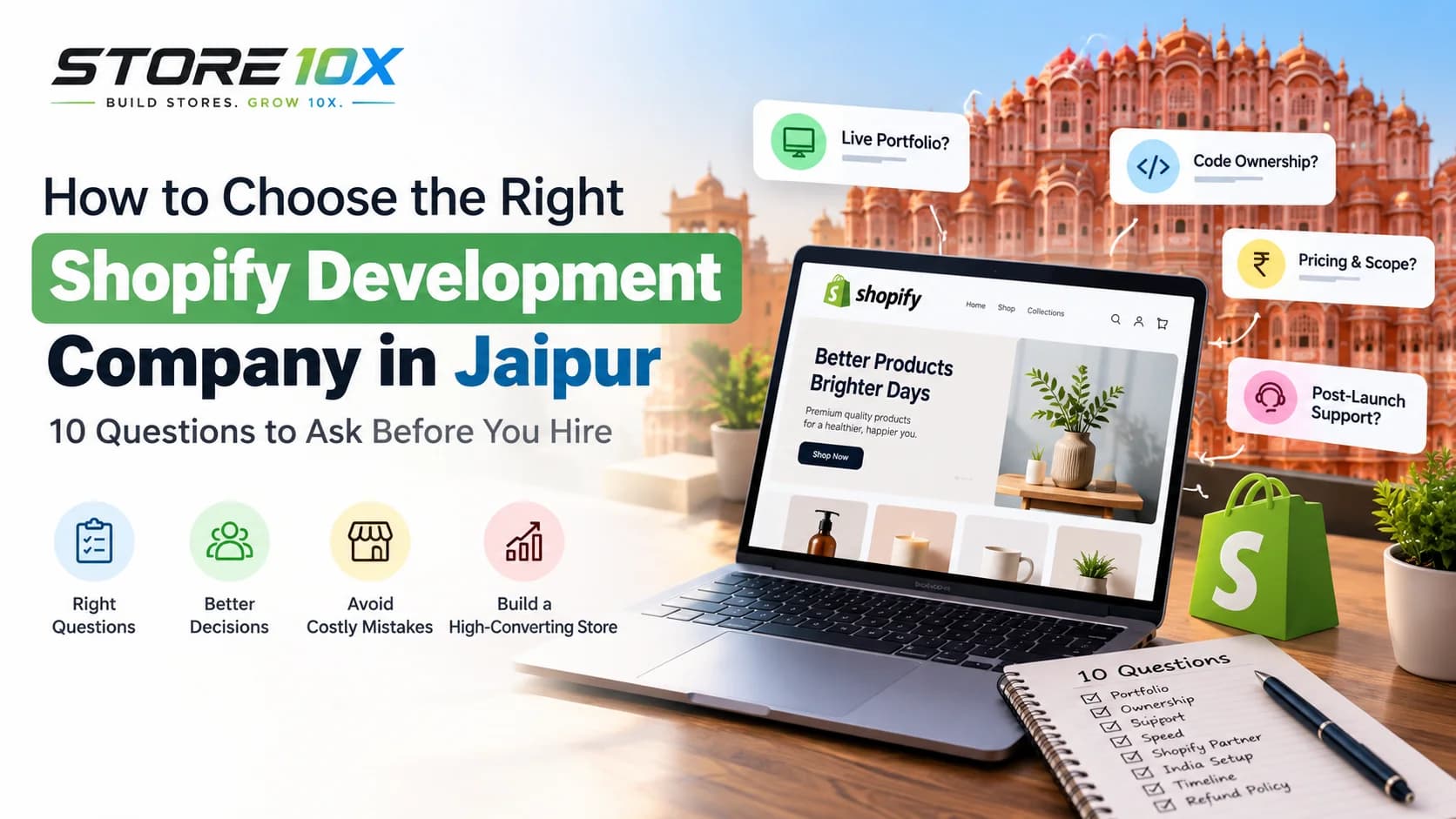
Before you sign with any Shopify development company in Jaipur, ask about: their live portfolio, who owns your code and theme after launch, what’s actually included in the price, who on their team will build your store, what support looks like after launch, how they handle mobile speed and checkout, whether they’re a registered Shopify Partner, and what happens if you’re unhappy with the result. The sections below explain why each question matters and what a good answer sounds like.
Why This Decision Is Harder Than It Looks
Jaipur has a growing number of Shopify development companies, agencies, and individual freelancers, and most of their websites look similar: “conversion-focused,” “custom builds,” “we scale your brand.” The difference between a good hire and a bad one rarely shows up in the pitch — it shows up three months later, when you need a small change made and can’t get a reply, or discover you don’t actually own the theme you paid for.
A wrong hire doesn’t just cost money. It costs the weeks you spend waiting, the redo work when you eventually switch providers, and — if the store launches with poor mobile performance or a confusing checkout — the sales you lose while it’s live. Asking the right questions upfront is the cheapest insurance you can buy. If you’re also thinking about how far your store can grow, our guide on how to scale Shopify sales in 2026 covers what a good build should support.
10 Questions to Ask Before You Hire
1. Can I see live stores you’ve actually built?
Ask for two or three live, currently-operating Shopify stores — not just design mockups or a portfolio page with screenshots. Open each one on your phone. Add a product to the cart and walk through checkout. A company that hesitates to show live work, or only has mockups to show, is a red flag.
2. Do I own 100% of the code, theme, and store after the project ends?
This should be a simple “yes,” in writing. Some agencies build on proprietary themes or keep admin-level control that makes it hard to leave later. Before signing, confirm you’ll have full ownership of the Shopify store, theme files, and any custom code — not a rented or locked-in setup.
3. What exactly is included in the price — and what isn’t?
“Custom Shopify store” can mean a fully bespoke build or a paid theme with your logo dropped in. Get a written scope: number of pages, product upload (who does it — you or them), apps included, whether payment gateway and shipping setup is covered, and how many rounds of revisions are included before extra charges apply.
4. Who will actually work on my project?
Some agencies sell the project on a senior team’s reputation, then hand execution to a junior freelancer or subcontractor. Ask who specifically will design, build, and be your point of contact — and whether that’s the same person throughout, or if you’ll be handed off partway through.
5. What does support look like after launch?
Shopify stores need occasional attention — a broken app, a theme update, a new collection page. Ask exactly what’s covered after launch: is there a free support window, what happens after it ends, and what’s the average response time for a fix. Get this in writing rather than a verbal “we’re always here for you.”
6. How do you handle mobile speed and checkout experience?
Since most shoppers in India buy on mobile, this matters more than almost anything else. Ask them to run your (or a comparable) store through Google PageSpeed Insights on mobile and explain the score. A company that can’t speak specifically about load time, image optimization, or checkout friction likely hasn’t prioritized it.
7. Are you a registered Shopify Partner?
The Shopify Partner Program is free to join and doesn’t by itself guarantee quality, but being a registered partner does mean the company has direct access to Shopify’s partner tools, unlimited development stores for testing, and Shopify Academy training. It’s a reasonable baseline check, not a substitute for the other questions on this list.
8. Do you understand Indian payment gateways, COD, and shipping logistics?
A Shopify store built without India-specific commerce in mind — Razorpay or Cashfree integration, Cash on Delivery, GST-compliant invoicing, and Indian shipping partners like Shiprocket or Delhivery — will create operational headaches after launch. Ask directly whether they’ve set this up before, not just “can you do it.”
9. What’s the actual process and timeline?
A believable answer sounds like: audit or discovery call, wireframe/design approval, development, a testing phase, then launch — with rough timeframes for each. Be cautious of vague timelines (“it depends”) with no milestone structure, since that’s usually where projects stall.
10. What happens if I’m not happy with the result?
Ask this directly before signing, not after a problem shows up. Is there a revision process? A partial refund policy? Does the contract specify what “done” looks like? A company confident in its process will have a clear answer ready.
Red Flags That Should Make You Walk Away
- They can’t show you a single live store they’ve built.
- The price is far below every other quote you’ve received — cheap builds usually cut corners on performance, QA, or code quality that you only discover after launch.
- No written scope or contract, just a verbal agreement over WhatsApp.
- They’re vague about who owns the code and theme after the project.
- They can’t explain their approach to mobile speed or checkout in specific terms.
What Shopify Development Typically Costs in Jaipur
Based on publicly listed pricing from Jaipur-based Shopify development companies, basic store setups commonly start in the ₹8,000–₹65,000 range, while fully custom builds with branding, app integrations, and marketing setup can run into several lakh rupees depending on scope. Monthly maintenance/support retainers are commonly priced separately, often starting around ₹9,000/month. Treat any number here as a starting reference, not a quote — get a written estimate based on your specific requirements before comparing providers.
A Quick Evaluation Checklist
| Question | What to look for |
|---|---|
| Live portfolio | 2–3 real, working stores you can test yourself |
| Code ownership | Written confirmation you own the theme/code after launch |
| Scope in writing | Pages, apps, revisions, and exclusions listed explicitly |
| Team clarity | Named point of contact, not “our team” vaguely |
| Post-launch support | Defined window and response time, in writing |
| Mobile/speed approach | Specific, testable answer — not just “we optimize for speed” |
| Shopify Partner status | Confirmed, as a baseline check |
| India-specific commerce | Experience with Razorpay/Cashfree, COD, GST invoicing, local shipping |
Why a Local Jaipur Company Can Still Be the Right Call
Shopify development can be done remotely from anywhere, so “local” isn’t a requirement — but it’s a genuine advantage for some businesses. A Jaipur-based team working in the same time zone means faster turnaround on quick requests, the option of an in-person meeting if something needs a whiteboard conversation, and — often — more direct familiarity with the Indian D2C logistics stack (COD-heavy checkouts, regional shipping partners, GST invoicing) than an overseas or fully remote team might have by default. It’s one factor among the ten questions above, not a replacement for them.
Frequently Asked Questions
Do I need Shopify Plus, or is standard Shopify enough?
Most D2C and small-to-mid retail brands in Jaipur do not need Shopify Plus at launch. Shopify Plus is built for high-volume merchants who need advanced checkout customization, higher API limits, and enterprise-level support — standard Shopify covers the needs of most growing stores well below that scale. Our comparison of Shopify vs Shopify Plus goes deeper on when an upgrade makes sense.
How long should a basic Shopify project take?
A basic store — standard theme customization, a handful of product/collection pages, and standard app integrations — commonly takes 5–15 working days depending on how quickly product content and approvals come back from your side. Fully custom builds with bespoke design take longer.
Can I switch Shopify development companies partway through a project?
Yes, but it’s disruptive and usually costly, since a new provider has to review someone else’s unfinished code and design decisions before continuing. This is exactly why the code-ownership and written-scope questions above matter — they determine how easy (or hard) a switch would be if it ever became necessary.
Next Step
If you’re evaluating Shopify development companies in Jaipur, use the ten questions above with every company you talk to — including us. Store10x offers a free store audit if you want a second opinion on an existing store, or a straight answer to these questions for a new build. You can also see our Shopify development services or go back to the homepage.